
Choosing safe AI game bots in 2026
The landscape for game automation in 2026 has shifted from a cat-and-mouse game of evasion to a high-stakes legal and technical minefield. Anti-cheat systems now leverage behavioral analysis and machine learning to detect non-human patterns with unprecedented accuracy. What was once a risk of a temporary suspension has escalated to permanent hardware bans and, in severe cases, legal action from publishers protecting their intellectual property and revenue streams.
Choosing "safe" requires a strict definition. Legitimate automation tools are designed to operate within the boundaries of Terms of Service (ToS), typically by automating repetitive tasks in single-player modes or cooperative environments where multiplayer advantage is not gained. These tools function as productivity aids rather than malicious cheats. They rely on transparent APIs or approved input simulation methods that do not inject code into the game client.
The primary filter for any tool in 2026 is its risk profile. Tools that interact with game memory or use external overlays to gain unfair advantages are instantly flagged. Safe bots mimic human input latency and behavior, ensuring they remain indistinguishable from legitimate players. Before investing time or money, verify that the tool explicitly states its compatibility with your game's current anti-cheat system and does not promise unfair competitive advantages.


| Feature | Safety Profile | Best Use Case | Risk Level |
|---|---|---|---|
| Input Simulation Bots | High | Single-player grinding | Low |
| Memory Injection Cheats | None | Multiplayer advantage | Critical |
| API-Based Assistants | Medium | Cooperative modes | Medium |
Top AI automation tools for 2026
The landscape of AI game bots has shifted from simple macro scripts to complex, agent-based systems capable of natural language interaction and adaptive decision-making. In 2026, the most effective automation tools are not just keystroke replays; they are sophisticated software agents that parse game environments, manage resources, and interact with NPCs using large language models. However, using these tools carries significant risk. Game developers actively monitor for anomalous behavior, and detection systems have become increasingly aggressive. Players must understand that while these tools offer efficiency, they operate in a legal gray area defined by each game’s Terms of Service. Violations can result in permanent account bans, loss of digital assets, and in rare cases, legal action for breach of contract or unauthorized access to computer systems.
Advanced Agent Frameworks
Modern AI bots function as autonomous agents, often leveraging open-weight models like Claude Sonnet 4.6 or Llama variants to interpret game states. These frameworks allow bots to handle complex quests, trade resources, and even socialize with other players by generating human-like text responses. The advantage is flexibility; unlike rigid scripts, these agents can adapt to game updates or unexpected events. However, this complexity increases the footprint. The computational overhead and the sheer volume of API calls to LLM providers can trigger anti-cheat flags. It is essential to run these agents on isolated virtual machines or separate hardware profiles to mitigate the risk of cross-account contamination. The legal risk here is high, as these tools often involve reverse-engineering game APIs, which may violate the Computer Fraud and Abuse Act in some jurisdictions.
Resource Gathering Optimizers
For grinding-focused gameplay, specialized resource gathering bots have evolved to mimic human movement patterns and error rates. These tools do not just auto-click; they use computer vision to identify high-value resources, calculate optimal routes, and simulate human hesitation to avoid detection. They are particularly useful for MMORPGs and idle games where time investment is the primary currency. The safety feature here is "humanization"—the ability to introduce random delays, mouse curves, and occasional mistakes. Without this layer, bots are easily identified by behavioral analytics. Players should be aware that while these tools save time, they often violate the core tenets of fair play outlined in game licenses. The economic impact of such tools can lead to inflation or market crashes in game economies, prompting developers to issue stricter bans.
NPC Interaction and Questing Bots
Questing bots represent the cutting edge of AI automation, using natural language processing to understand quest objectives and navigate dialogue trees. These tools can read in-game text, interpret NPC motivations, and choose responses that maximize reputation or rewards. This level of automation is particularly prevalent in text-heavy RPGs and simulation games. The primary risk is that these bots can be detected by pattern analysis; if a player’s dialogue choices are statistically too perfect or too fast, it raises suspicion. Also, using AI to bypass content designed for manual engagement may be considered a breach of the End User License Agreement (EULA). Legal experts warn that game companies are increasingly using digital rights management (DRM) and watermarking to trace and ban accounts using unauthorized software.
Essential Hardware for Safe Automation
Running AI bots requires reliable hardware that can operate 24/7 without crashing. A dedicated machine with sufficient RAM and a robust cooling system is essential to handle the computational load of running both the game client and the AI agent simultaneously. Using a separate PC or a cloud-based virtual private server (VPS) is often recommended to isolate the botting activity from your primary gaming rig. This separation helps in managing network traffic and reduces the risk of your main device being flagged. Additionally, investing in a reliable internet connection and a UPS (Uninterruptible Power Supply) ensures that the bot does not crash mid-session, which can lead to incomplete actions and increased detection risk. The cost of this hardware is a necessary investment for anyone serious about long-term automation.


As an Amazon Associate, we may earn from qualifying purchases.
Navigating Legal and ToS Risks
Before deploying any AI bot, it is critical to review the specific Terms of Service (ToS) of the game in question. Most major game publishers explicitly prohibit the use of third-party automation software. Violating these terms can result in immediate and permanent bans. In some cases, developers have taken legal action against bot developers and, in rare instances, users. It is also important to consider the ethical implications of using bots, as they can disrupt the economy and experience for other players. While the technology is impressive, the consequences of getting caught can be severe. Always prioritize account security and legal compliance over short-term gains. The tools available in 2026 are powerful, but they are not invincible, and the risk of losing your digital investments is real.
Safety Features and Detection Risks
The line between automation and cheating is enforced by increasingly aggressive anti-cheat systems. In 2026, game developers are integrating machine learning models that analyze input patterns, mouse movements, and keystroke timing to identify non-human behavior. Using a bot without robust evasion capabilities is not just a risk of a temporary suspension; it is a direct violation of Terms of Service that can lead to permanent account termination and hardware bans.
The following comparison evaluates the top AI game bots based on their current anti-detection capabilities, human-like behavior simulation, and update frequency. These metrics determine whether a tool remains functional or becomes a liability for your account.
| Tool | Detection Evasion | Human-like Input | Update Frequency |
|---|---|---|---|
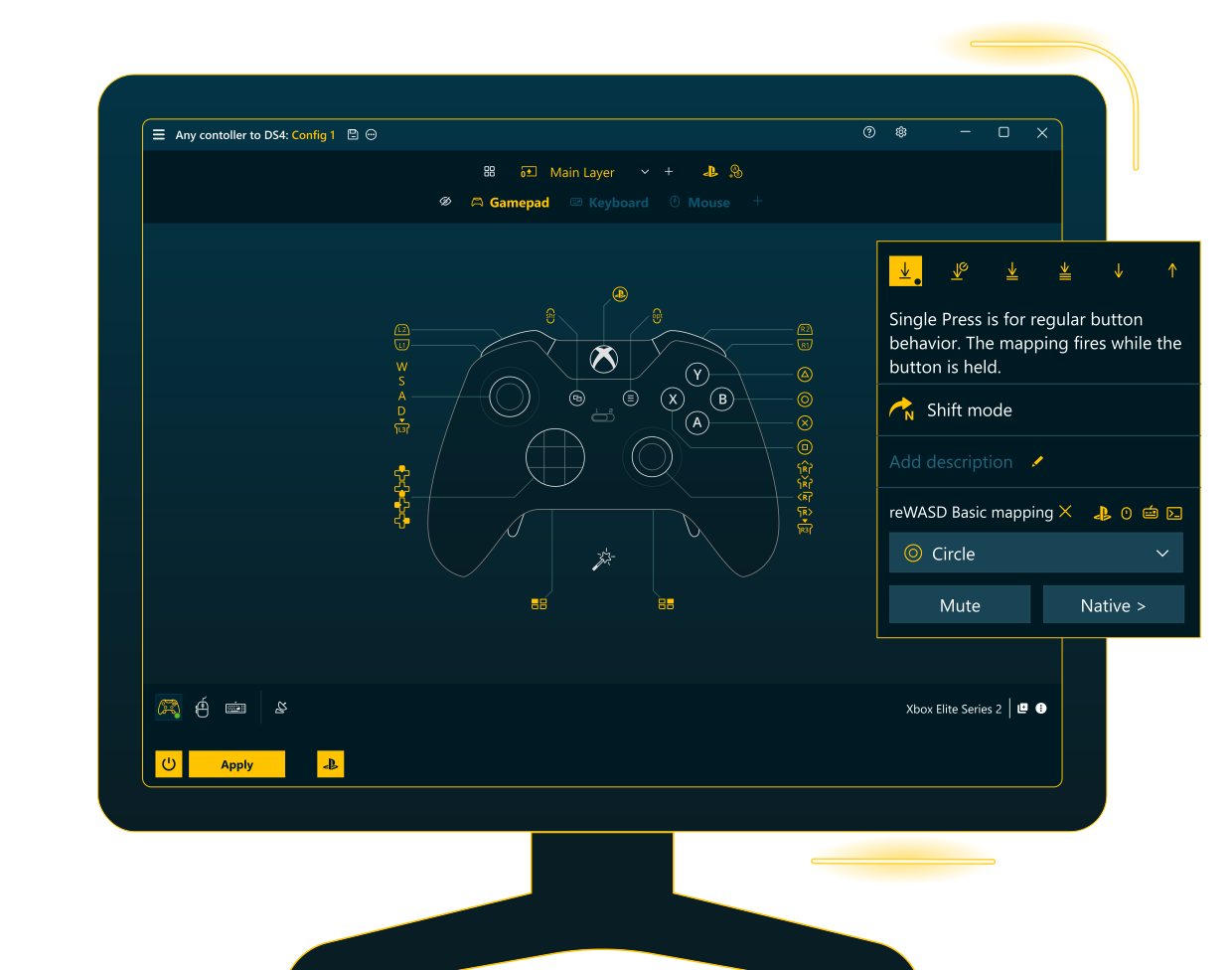
| ReWASD | Low | Moderate | Weekly |
| XIM Apex | Low | High | Monthly |
| Panda Mouse Pro | Medium | High | Daily |
| AutoHotkey (Custom) | High | Low | Manual |
ReWASD and XIM Apex rely on hardware-level or driver-level abstraction, which makes them harder for in-game software to detect directly. However, they often lack sophisticated behavioral smoothing, meaning your mouse movements might still appear too linear or precise for human standards. Panda Mouse Pro attempts to bridge this gap by adding randomization to inputs, but it requires constant tweaking to avoid pattern recognition algorithms.
Custom scripts built with AutoHotkey offer the most control but carry the highest risk. Without dedicated anti-detection libraries, these tools often fail to mimic the micro-jitters and inconsistencies of human input, making them easy targets for modern anti-cheat systems like Easy Anti-Cheat or BattlEye. Always verify the current status of any tool against the latest game patches before use.

As an Amazon Associate, we may earn from qualifying purchases.
The legal and ethical lines
Using AI bots to grind in games sits in a gray zone that is rapidly becoming a legal no-go. Game publishers treat their Terms of Service (ToS) as binding contracts. When you use automation tools, you are almost certainly violating those terms. This isn't just about getting kicked from a lobby; it is about account termination and potential legal action.
The risk extends beyond simple bans. If your bot uses AI to generate assets, you may be infringing on copyright laws. Recent legal analyses highlight that AI-generated content often lacks copyright protection. This means competitors can legally copy your unique assets, leaving you with no legal recourse to stop them. Also, using unauthorized bots can expose you to claims of unauthorized access under computer fraud statutes.
Official sources emphasize that the landscape is shifting toward stricter enforcement. Publishers are increasingly using anti-cheat systems that detect not just macro patterns, but the subtle, non-human behaviors of AI agents. The consequence is a permanent ban. Do not assume that because a tool is "undetectable" today, it will remain so. The legal and ethical cost of automation is far higher than the temporary gain of free grinding.
Frequently Asked Questions About AI Game Bots
Will there be AI game engines in 2026? Yes. The 2026 landscape is defined by AI-native game engines that integrate automated asset generation and smart NPC behavior directly into the development workflow. These tools are shifting from experimental add-ons to core infrastructure for studios and independent creators alike.
Is it legal to make a game with AI? Legality depends on output ownership, not just creation. According to legal analysis, AI-generated assets often lack copyright protection, meaning competitors can legally copy or imitate them. Studios must navigate this "ownership gap" carefully to protect their intellectual property.
What AI is coming in 2026? The focus is shifting from chatbots to autonomous agents. New open-weight models are designed from the start for tool use, structured outputs, and long-context reasoning. These agent-ready models power more autonomous workflows, allowing AI to handle complex tasks rather than just generating text.
What is the new AI bot in 2026? Anthropic’s Claude Opus 4.6 and Claude Sonnet 4.6 are leading the charge in 2026. Known for calm, highly contextual responses, these models offer stronger reasoning and coding abilities with extended context handling, making them suitable for complex game bot logic and narrative generation.
No comments yet. Be the first to share your thoughts!