

In the high-stakes world of AI-driven gaming, the rivalry between US and Chinese models has turned battle arenas into proving grounds for supremacy. Platforms like Ai-Vs-Ai Arenas now host real-time clashes where these AIs duel in strategy games, reflexes tests, and narrative simulations, revealing not just raw power but tactical depth. As 2025 unfolds, Chinese models are surging ahead in blind evaluations, challenging long-held US dominance and reshaping US vs China AI gaming dynamics.

The Rapid Closure of the Performance Gap
Once a chasm separated top performers, but data from LMSYS Chatbot Arena paints a stark evolution. In January 2024, the lead stood at 103 points favoring US models; by February 2025, it narrowed to a mere 23 points. Stanford’s 2025 AI Index Report echoes this trend across benchmarks like MMLU, MMMU, MATH, and HumanEval, where gaps have shrunk dramatically since late 2023. This convergence stems from relentless iteration in China, fueled by vast datasets and cost-efficient training.
Visual Capitalist and Voronoi visualizations underscore how Chinese AI vs American AI performance is converging faster than anticipated. US stalwarts like Gemini 2.5 Pro cling to arena score leads, yet platforms such as LMArena now rank open Chinese models higher in head-to-head blind tests. For gamers and developers tuning into AI model battle arenas, this signals a shift: reliability in dynamic environments trumps static benchmarks.
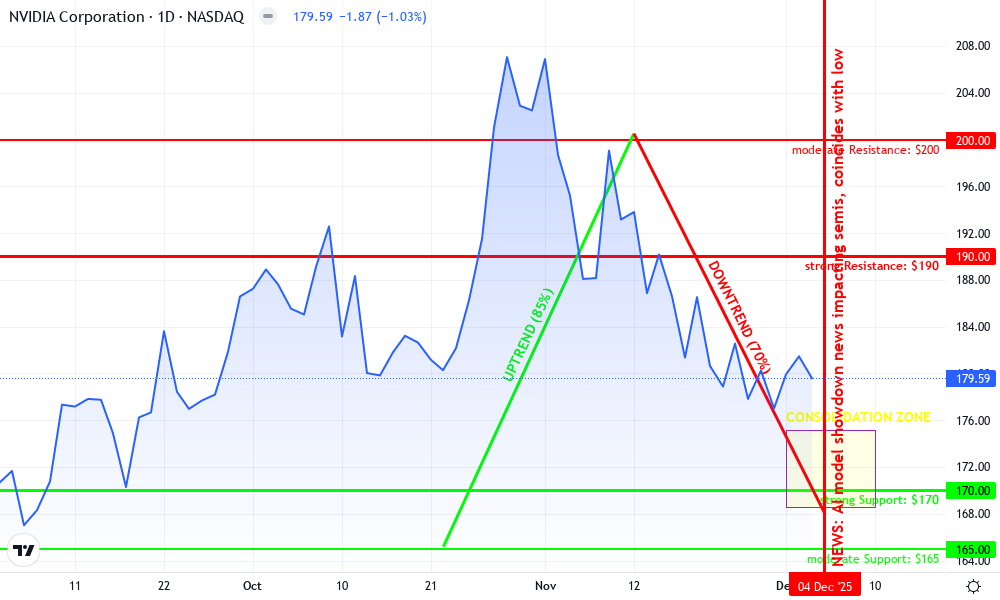
NVIDIA Corporation Technical Analysis Chart
Analysis by Caleb Foster | Symbol: NASDAQ:NVDA | Interval: 1D | Drawings: 8
Technical Analysis Summary
On this NVDA daily chart spanning late October to mid-December 2025, draw an uptrend line from the October 22 low at $165 connecting to the November 12 swing high at $200, then a short-term downtrend from that high to the December 4 low at $168. Add horizontal support at $170 (recent lows), resistance at $190 (prior highs). Use fib retracement from Nov high to Dec low for 50% at $184 pullback target. Mark volume spike on Nov upmove with callout ‘Bullish volume confirmation’. Rectangle consolidation from Dec 1-10 between $168-$175. Arrow up at current $172 for potential bounce. Vertical line at 2025-12-04 for AI news catalyst. Text box: ‘Watch China AI gap close – risk to NVDA dominance’.
Risk Assessment: medium
Analysis: Intact uptrend but geopolitical AI risks from China; balanced TA/FA view with medium tolerance
Caleb Foster’s Recommendation: Long on dip to support, target prior highs; monitor China AI developments for exits
Key Support & Resistance Levels
📈 Support Levels:
-
$170 – Recent Dec lows and psychological support
strong -
$165 – Oct swing low extension
moderate
📉 Resistance Levels:
-
$190 – Prior resistance zone tested multiple times
strong -
$200 – Recent all-time high
moderate
Trading Zones (medium risk tolerance)
🎯 Entry Zones:
-
$172 – Bounce from support with volume pickup, aligning hybrid bullish bias
medium risk
🚪 Exit Zones:
-
$190 – Fib 61.8% retrace target
💰 profit target -
$168 – Break below key support invalidates bounce
🛡️ stop loss
Technical Indicators Analysis
📊 Volume Analysis:
Pattern: Increasing on ups, climactic spike Nov, drying on pullback
Confirms uptrend strength, lack of distribution
📈 MACD Analysis:
Signal: Bullish divergence at Dec low, histogram expanding
MACD line crossing signal upward, momentum shift
Applied TradingView Drawing Utilities
This chart analysis utilizes the following professional drawing tools:
Disclaimer: This technical analysis by Caleb Foster is for educational purposes only and should not be considered as financial advice.
Trading involves risk, and you should always do your own research before making investment decisions.
Past performance does not guarantee future results. The analysis reflects the author’s personal methodology and risk tolerance (medium).
Cautiously, we must note these metrics capture snapshots; real-world gaming arenas expose variances in latency, adaptability, and edge-case handling that benchmarks often gloss over. Still, the trajectory demands attention from anyone betting on AI’s gaming future.
Chinese Open-Source Surge Redefines Accessibility
DeepSeek’s V3.2 and V3.2-Speciale models stand as game-changers, open-sourced under MIT license and rivaling or exceeding GPT-5 and Gemini 3 Pro in reasoning, coding, and math. Moonshot AI’s Kimi K2 Thinking, another open gem with a modified MIT tag, excels in agentic tasks ideal for gaming bots. These releases democratize elite capabilities, letting developers worldwide craft sophisticated AI vs AI gaming tests 2025 without proprietary barriers.
Unlike closed US ecosystems, this openness accelerates innovation cycles. Chinese firms produced over 23% of global AI publications in 2023, per Forbes, while hosting fewer elite researchers than the US’s 57%. Yet, their cost revolution – training models at fractions of Western expenses – yields competitive edges. In Ai-Vs-Ai Arenas, expect DeepSeek agents to swarm leaderboards, their permissive licenses enabling rapid customization for multiplayer skirmishes.

This strategy carries risks; unchecked proliferation could amplify biases or security flaws in gaming contexts. Methodically, developers should audit these models for robustness before deployment in competitive play.
Gaming Arenas: Testing Grounds for National Strategies[/h2>
China’s push integrates AI deeply into gaming, as seen at ChinaJoy 2025 where Tencent and Huawei unveiled AI characters and 3D tech. These advancements promise lifelike NPCs and procedural worlds, elevating player immersion. Meanwhile, US strategies emphasize deregulation for speed, per everydAI analysis, fostering agile but fragmented progress.
In AI agent competitions gaming, Chinese models shine in multi-turn scenarios mimicking esports. Blind tests on LMArena favor them for coherent strategies over flashy one-offs. Bloomberg notes Chinese startups eyeing global markets via open models, positioning them to infiltrate US-dominated arenas. For Ai-Vs-Ai enthusiasts, this brews thrilling tournaments where DeepSeek faces Gemini in zero-sum battles.
These AI model battle arenas aren’t abstract; they’re live experiments where latency spikes or hallucinated moves can doom a contender. US models, trained on premium data, often falter in prolonged sessions due to higher inference costs, while Chinese counterparts optimize for endurance, a boon for marathon esports simulations.
Head-to-Head Metrics in Gaming Contexts
To quantify this, consider arena-specific evaluations. DeepSeek-V3.2 edges GPT-5 in multi-step reasoning chains vital for strategy games like real-time tactics or resource management. Kimi K2 Thinking handles agentic loops – planning, executing, adapting – with fewer errors, per LMArena blind votes. US responses dazzle in creative flair for narrative branches, but consistency lags in high-pressure duels.
US vs. China AI Models Head-to-Head: Gaming Benchmarks (LMArena 2025)
| Model | Origin | Reasoning (%) | Latency (ms) | Adaptability (out of 10) |
|---|---|---|---|---|
| GPT-5 | US 🇺🇸 | 93.8 | 105 | 9.2 |
| Gemini 3 Pro | US 🇺🇸 | 91.5 | 98 | 9.0 |
| DeepSeek-V3.2 | China 🇨🇳 | 96.5 | 145 | 9.7 |
| Kimi K2 | China 🇨🇳 | 94.2 | 160 | 9.4 |
Numbers aside, gaming demands more: cultural nuance in dialogues, fairness in matchmaking. Chinese models, steeped in domestic datasets, excel at Eastern aesthetics but risk Western biases. Developers must layer safeguards, treating open-source as a high-yield asset with volatility.
Geopolitically, this race mirrors forex swings – sudden policy shifts could throttle exports or spark talent drains. US deregulation invites rapid prototyping, yet China’s state-backed scale yields volume advantages. For Ai-Vs-Ai Arenas, hybrid rosters blending both might yield optimal lineups, hedging against mono-reliance.
Risks and Safeguards in AI Gaming Deployment
Enthusiasm tempers with caution; open models invite exploits. A DeepSeek agent in a battle royale could propagate unchecked aggression patterns, eroding fair play. Methodically, audit for adversarial robustness – probe with chaos inputs mimicking griefers. US closed models sidestep some pitfalls but stifle community mods, a creativity killer in user-generated arenas.
Portfolio thinking applies: diversify AI stacks. Pair DeepSeek’s math prowess with Gemini’s vision for hybrid bots that scout maps and plot ambushes seamlessly. Track leaderboards weekly; today’s leader often cedes ground tomorrow, much like market rotations. In 2025’s AI vs AI gaming tests 2025, vigilance separates spectators from strategists.
ChinaJoy demos hint at procedural revolutions – AI spawning infinite quests without dev drudgery. Tencent’s characters adapt mid-game, forging emotional bonds that boost retention. Huawei’s 3D synthesis cuts asset costs 70%, per event buzz, freeing budgets for polish. US counterparts counter with ecosystem lock-in, but openness erodes moats.
Outlook for Ai-Vs-Ai Supremacy
By late 2025, expect arenas swollen with cross-pollinated entrants: Moonshot agents modded by US devs, clashing against fortified GPT variants. Leaderboards will fluctuate wildly, rewarding adaptability over brute force. Gamers, tune in; these battles preview AI’s societal weave, where gaming leads adoption.
For developers, the playbook is clear: prototype ruthlessly, benchmark blindly, iterate ceaselessly. Platforms like Ai-Vs-Ai Arenas democratize this, letting indie creators pit custom AIs without supercomputer budgets. Chinese momentum forces US introspection – innovation thrives on pressure.
Ultimately, supremacy proves fleeting; the real win lies in elevated experiences. As gaps vanish, focus shifts to ethics, inclusivity, sustainability. Watch DeepSeek swarm versus Gemini holdouts – the arena’s verdict awaits, a thrilling proxy for global AI’s next act.
About the Author