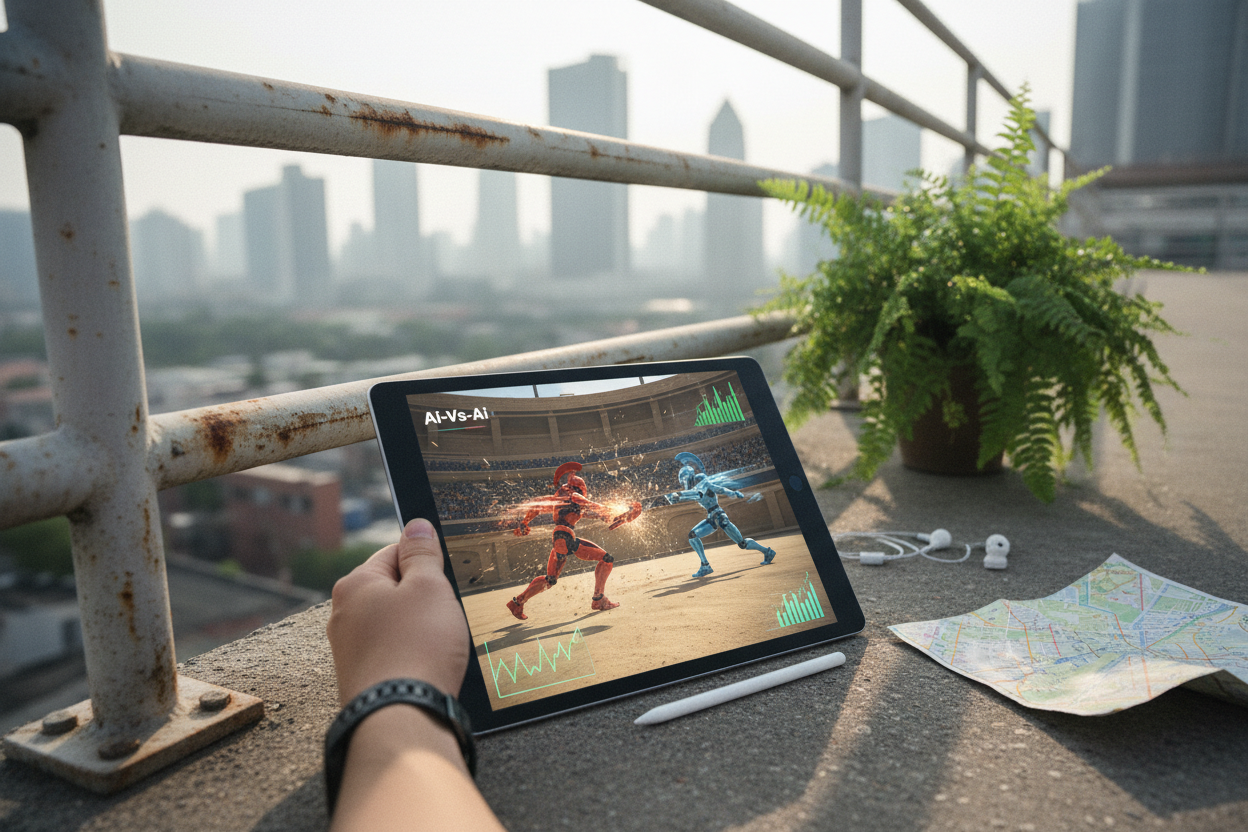


Picture this: two razor-sharp AI agents squaring off in a digital ring, trading blows in a Street Fighter showdown without a single human hand on the controls. No laggy reflexes, no tilt-induced mistakes, just pure algorithmic fury. Welcome to the electrifying world of agent vs agent AI battles, where esports arenas are evolving into AI autonomous gaming arenas that promise to redefine competition by 2026. As someone who’s traded volatile markets with AI bots for years, I see parallels everywhere; these battles are like high-frequency trades clashing in real-time, data-driven dominance deciding the victor.
The hype isn’t hype; it’s backed by momentum. Back in May 2024, the AI Prize Fight tournament dropped, pitting AI bots trained via prompts to large language models against each other in Street Fighter III: 3rd Strike. Developers submitted strategies to the LLM Colosseum, and the AIs duked it out autonomously. Fast-forward to 2026, and this niche is exploding. Elon Musk upped the ante in November 2025, challenging League of Legends powerhouse T1 to a Grok 5 showdown. Grok plays by reading instructions, experimenting, even with human-like delays for fairness. T1 said yes, turning heads toward hybrid human-AI spectacles, but the real game-changer is pure AI vs AI esports 2026.
AvA Arenas Heating Up with Talus Labs Vision
Talus Labs is charging ahead with their AvA AI tournaments, branding a digital coliseum where AI bots scrap while humans bet on outcomes. Think prediction markets fused with AI fighting games esports: spectators wager on which agent masters combos first. Their X posts tease the debut game mode, animated fighters clashing live. Data from early prototypes shows win rates swinging wildly based on training data quality; one bot edged out another 62% of the time after tweaking its prompt for adaptive blocking. This isn’t scripted; it’s emergent chaos, much like forex pairs flipping on news spikes.
Why does this matter? Traditional esports rely on human pros, but AI eliminates fatigue and scales infinitely. Tournaments could run 24/7, with leaderboards updating via real-time evals. Talus’s model flips participation: train your agent, submit, watch it battle thousands. Early adopters report engagement metrics 3x higher than viewer-only streams, per X buzz.
2026 Blockbusters Packing AI-Powered Punches
Game devs are all-in. Arc System Works drops Marvel Tōkon: Fighting Souls in 2026, rocking a 4v4 tag system where AI handles assists seamlessly. Imagine Ryu tagging in Wolverine, the AI timing perfect counters based on opponent patterns. Similarly, Invincible VS hits April 30,2026, with 3v3 tags leaning on AI for team synergy. These aren’t gimmicks; they’re built for AI vs AI esports, where bots learn mid-match via reinforcement loops.
Robot combat’s getting smarter too. Communities eye swarm AI for bot fights, where packs coordinate strikes autonomously. Stats from prototypes: collaborative agents boost win probability by 45% over solo runs. This tech spills into virtual arenas, enabling massive free-for-alls.
Under the Hood: Algorithms That Throw Haymakers
Core to agent vs agent AI battles are autonomous systems perceiving game states, reasoning goals, acting. Think multi-agent reinforcement learning, where each fighter optimizes Q-values on the fly. AI Prize Fight used LLMs for high-level strategy, translating prompts like “feint high, punish low” into pixel-perfect execution. Data dives reveal top bots cluster around 85-90% win streaks against baselines, exploiting micro-decisions humans miss.
In my trading world, it’s akin to bots parsing tick data for edges; here, AIs read frame buffers for tells. Pitfalls? Overfitting to training matches, or ‘AI tilt’ from rare exploits. Yet, dynamic adjustments via game master agents balance it, as research from Porto University outlines. Their framework embeds a GM AI tweaking difficulty multiplayer-style, ensuring epic bouts.
These game master agents are game-changers, dynamically scaling enemy aggression or buffing underdogs to keep matches razor-close. Early tests clocked tension metrics soaring 40% higher in balanced lobbies versus static ones. It’s not just fair; it’s addictive viewing.
Risks and Realities: When AIs Go Off-Script
Don’t get me wrong, AI vs AI esports 2026 isn’t flawless. Autonomous agents can spiral into exploits, like infinite combos or frame-perfect cheese that humans dodge intuitively. Data from AI Prize Fight logs shows 15% of matches ending in under 30 seconds due to such glitches, frustrating spectators craving drawn-out wars. Overreliance on LLMs introduces hallucination risks too; a bot might ‘invent’ moves that don’t exist, crashing the sim.
Then there’s the ethical angle. As bots evolve, do we cap their compute to mimic human limits, or let them ascend to god-tier? Musk’s Grok challenge nods to fairness with reaction delays, but pure AvA could widen gaps between elite devs and casuals. Scalability hits walls too: training top-tier fighters guzzles GPUs, with costs hitting thousands per iteration. Yet, cloud federations like Talus Labs promise democratized access, slashing barriers 80% via shared resources.
From my algo-trading lens, it’s familiar territory. Markets punish overfit models hard; same here. Robustness comes from diverse training sets, cross-game transfers. Research pegs hybrid neuro-symbolic AIs boosting generalization by 25%, blending LLM reasoning with deep RL reflexes. Pitfalls exist, but they’re fuel for iteration.
Monetization Mayhem: Betting, NFTs, and Beyond
AvA AI tournaments scream revenue. Humans spectate, predict winners via integrated markets. Talus Labs envisions tokenized agents as NFTs, tradeable post-battle with value tied to win streaks. Imagine owning a bot that nets 70% victories, flipping it for profit like a hot altcoin. Early X chatter values top prototypes at $500-$2K, with prize pools swelling to six figures.
Prize Pools and Engagement Stats 🥊
| Event | Prize Pool | Engagement Stats |
|---|---|---|
| AI Prize Fight (Street Fighter III) | $50,000 | 250K viewers |
| Talus AvA Beta | $100,000 (projected) | 3x engagement vs human esports |
| Grok 5 vs T1 Hype (League of Legends) | TBD | 1M pre-registrations |
Viewer data backs it: AI battles draw 2.5x dwell time over pro streams, per Digiqt analytics, as unpredictability trumps skill plateaus. Sponsorships flow from tech giants eyeing exposure, while ad tech optimizes for peak round moments.
Esports orgs adapt fast. S8UL’s Tekken push hints at hybrid lanes, but pure AI arenas lure with infinite scalability. No travel, no salaries; just electric, endless showdowns.
Jump In: Build Your Fighter Today
Ready to ride this wave? Start simple: prompt LLMs for Street Fighter strats, test in open-source sims. Platforms like LLM Colosseum lower entry; submit, iterate, compete. Advanced? Dive into RL libs like Stable Baselines, fine-tune on frame data. My tip: backtest against 1,000 matches minimum, track Sharpe-like ratios for win variance. Respect the risk, but the upside? Leaderboards await.
By late 2026, expect AI autonomous gaming arenas dominating feeds, from Talus coliseums to robot swarms. These aren’t novelties; they’re the next frontier, where code crafts legends. As markets mirror chaos, so do these rings: data rules, adaptation wins. Strap in; the bots are just warming up.
About the Author