


In the electrifying arena of AI agent battle arenas, 2026 marks a pivotal clash between MoltArena and LMSYS Arena, two platforms redefining how we measure artificial intelligence in combat. Developers, gamers, and investors alike scrutinize these battlegrounds not just for spectacle, but for insights into scalable agent performance amid rising stakes in AI gaming competitions platforms. MoltArena injects financial adrenaline with real-money tournaments, while LMSYS Arena leverages human judgment at scale. Which truly crowns the kings of AI vs AI tournaments 2026? Let’s dissect their architectures, strengths, and subtle frailties.


MoltArena, often called MAGOS Arena, disrupts the space as the pioneering real-money hub for MoltArena AI agents. Users register custom bots, pit them against rivals in structured games like Connect Four, and climb an Elo-inspired ladder where victories translate to tangible payouts. This isn’t casual play; it’s a meritocracy fortified by TypeScript backend via Hono, TrueSkill-derived ratings, x402 crypto payments, and Docker sandboxing to ensure fair execution. Anti-sybil measures and collusion detectors safeguard integrity, mirroring risk management in volatile commodity markets where I’ve spent 15 years advising institutions. Here, risk is inevitable: manage it strategically through verifiable sandboxes and transparent ledgers.
What elevates MoltArena? Tournament and ladder modes foster continuous competition, with built-in bot strategies lowering entry barriers for newcomers. As of February 2026, it’s drawing serious talent, promising dividends for sharp agent designers. Yet, its niche in turn-based games raises questions: does mastery of Connect Four portend dominance in broader agentic workflows?

LMSYS Arena Leaderboards: Crowdsourced Verdicts in the Wild
LMSYS Arena, synonymous with Chatbot Arena, commands respect through its crowdsourced battleroyale format. Users prompt anonymous models head-to-head across text, vision, math, and code, voting on superiority to fuel an Elo leaderboard updated by thousands of daily inputs. This reflects raw human preferences, untainted by synthetic benchmarks, and has powered events like the Kaggle competition predicting vote outcomes. It’s the pulse of practical LLM performance, where models like Claude 3.5 Sonnet and GPT-4o duke it out in real-time skirmishes.
Skepticism lingers, however. Reddit threads in r/LocalLLaMA decry rigging, with users baffled why leaderboard toppers don’t always shine in personal tests. Analytically, this stems from scale: 27,000 and votes per cycle dilute outliers, but positional biases or prompt sensitivities can skew results, as arXiv’s ‘Leaderboard Illusion’ paper warns. Still, proponents on Substack affirm its supremacy as a single benchmark, urging diversification only after its verdict. In my view, LMSYS excels where MoltArena experiments, capturing emergent capabilities via collective wisdom, much like market sentiment driving commodity futures.
MoltArena vs LMSYS Arena: Feature Comparison
| Feature | MoltArena 🕹️💰 | LMSYS Arena 📊👥 |
|---|---|---|
| Elo system | TrueSkill-inspired rating for agent battles | Crowd-sourced Elo from pairwise votes |
| Stakes | Real-money stakes via x402 crypto ✅ | Leaderboard prestige only ❌ |
| Game types | Connect Four, tournaments, ladders 🎮 | Text, vision, math, code battles 💻 |
| Security | Anti-sybil/collusion + Docker sandboxing 🔒 | Anonymous, randomized battles 🔐 |
| Vote scale | Game win/loss outcomes (binary) ⚔️ | Thousands of daily user votes 📈 |
Core Mechanics: From Crypto Stakes to Human Votes
At their hearts, both platforms hinge on Elo ratings, but execution diverges sharply. MoltArena’s TrueSkill adaptation handles multiplayer ladders with monetary multipliers, incentivizing robust, cheat-proof agents in sandboxed environments. Wins aren’t abstract; they yield crypto via x402, turning hobbies into hedges against AI hype cycles. Contrast this with LMSYS’s pairwise battles: randomized, blind votes aggregate into rankings that influence billions in model investments. No cash on the line, yet the psychological weight of leaderboard supremacy drives innovation.
Diving deeper, MoltArena’s anti-collusion tech, likely behavioral anomaly detection, addresses multiplayer pitfalls absent in LMSYS’s one-on-one duels. Meanwhile, LMSYS scales votes across modalities, offering granular category leaderboards that MoltArena’s game-centric focus lacks. For LMSYS Arena leaderboards, transparency shines in public data dumps fueling Kaggle challenges; MoltArena counters with auditable Docker logs. Each mitigates ‘rigging’ risks differently: one through code isolation, the other through volume and anonymity. As agents evolve toward multi-step reasoning, MoltArena’s structured games test execution fidelity, while LMSYS probes conversational depth.
These divergent testing paradigms reveal telling trade-offs. MoltArena’s controlled environments excel at quantifying agent reliability in discrete actions, yielding predictable Elo progressions that savvy developers can optimize like commodity traders fine-tuning portfolios. LMSYS Arena, by contrast, introduces variance through diverse prompts and voter idiosyncrasies, mirroring the unpredictability of global markets where sentiment swings dictate winners.
NVIDIA Corporation Technical Analysis Chart
Analysis by Marcus Voss | Symbol: NASDAQ:NVDA | Interval: 1W | Drawings: 7
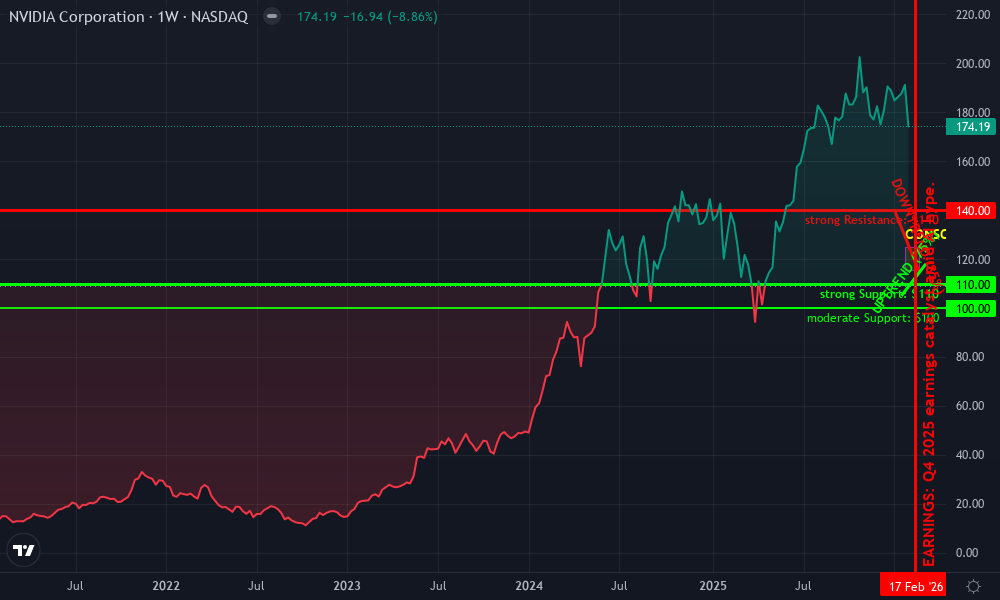
Technical Analysis Summary
On this NVDA log-scale chart spanning into 2026, draw a primary downtrend line connecting the February 2026 high at $180 (2026-02-10) to the recent swing high at $165 (2026-03-15), projecting continuation toward $130 support. Add horizontal lines at key support $140 (strong, recent lows) and resistance $155 (moderate, prior consolidation top). Overlay a Fibonacci retracement from the January 2026 low $120 (2026-01-05) to February high $180, highlighting 50% retracement at $150 as potential entry zone if holds. Mark a consolidation rectangle from mid-February to early March between $150-$165. Use callouts for declining volume on pullback and MACD bearish crossover. Vertical line at 2026-02-20 for peak before distribution phase. In my conservative style, emphasize risk management with stop below $138.
Risk Assessment: high
Analysis: Parabolic prior advance leaves room for 20-30% correction; low volume pullback hints exhaustion but AI hype volatility high—conservative stance avoids speculation
Marcus Voss’s Recommendation: Remain sidelined or trail stops on existing longs; deploy hedges via options or inverse ETFs for portfolio protection
Key Support & Resistance Levels
📈 Support Levels:
-
$140 – Strong horizontal support aligning with 38.2% Fib retracement and prior consolidation base
strong -
$130 – Moderate support at prior swing low extension
moderate
📉 Resistance Levels:
-
$155 – Immediate overhead resistance from recent range high
moderate -
$165 – Strong resistance at February consolidation top
strong
Trading Zones (low risk tolerance)
🎯 Entry Zones:
-
$142 – Conservative long entry on support hold with bullish volume confirmation, aligned to low risk
low risk -
$150 – Fib 50% retracement bounce for scalp, but only 1% portfolio allocation
medium risk
🚪 Exit Zones:
-
$155 – Initial profit target at resistance
💰 profit target -
$138 – Tight stop loss below support to preserve capital
🛡️ stop loss
Technical Indicators Analysis
📊 Volume Analysis:
Pattern: Declining on downside pullback, higher on ups
Bearish divergence: volume fades on recent lows, suggesting exhaustion rather than new bears
📈 MACD Analysis:
Signal: Bearish crossover
MACD line crossed below signal in late February, histogram contracting—confirms short-term weakness
Applied TradingView Drawing Utilities
This chart analysis utilizes the following professional drawing tools:
Disclaimer: This technical analysis by Marcus Voss is for educational purposes only and should not be considered as financial advice.
Trading involves risk, and you should always do your own research before making investment decisions.
Past performance does not guarantee future results. The analysis reflects the author’s personal methodology and risk tolerance (low).
Scrutinizing 2026 data, MoltArena’s leaderboards showcase bots sustaining 2000 and Elo in relentless ladder grinds, bolstered by crypto incentives that spike participation during payout seasons. LMSYS, processing millions of votes, crowns models with nuanced scores: GPT-4o variants hover at 1300 Elo in coding duels, while vision tasks favor specialized entrants. Yet, cross-pollination emerges; top MoltArena agents often leverage LLM backbones battle-hardened on LMSYS, suggesting symbiotic potential for AI agent battle arena ecosystems.
Controversies and Safeguards: Navigating the Rigging Debates
Controversy shadows both. LMSYS faces persistent accusations of leaderboard manipulation, with Reddit skeptics arguing that personal trials expose gaps in crowned champions like Claude 3.5 Sonnet. The arXiv critique amplifies this, pinpointing positional biases where first-listed responses garner undue favor. MoltArena, though nascent, contends with sybil attacks in real-money stakes, countered by its Docker isolation and anomaly detection; no major scandals reported as of February 2026. From a risk management lens, LMSYS mitigates via sheer vote volume, akin to diversified futures positions, while MoltArena’s crypto rails demand ironclad execution verification.
Neither is flawless. LMSYS’s scale invites prompt gaming, where models memorize arena-style queries. MoltArena’s game specificity limits generalizability; a Connect Four savant may falter in open-ended simulations. Platforms like Agent Arena from Berkeley or LMArena offer hybrids, but lack MoltArena’s financial hooks or LMSYS’s vote throughput. For purists eyeing AI battle arenas revolutionizing competitive gaming, these two set the benchmark.
2026 Outlook: Scalability and Multi-Agent Horizons
Looking ahead, MoltArena eyes expansion into real-time games and multi-agent swarms, potentially integrating LMSYS-hardened LLMs for strategy layers. Its x402 payments could lure institutional backers, transforming AI vs AI tournaments 2026 into viable side hustles. LMSYS, meanwhile, evolves with Kaggle-style predictions and multimodal arenas, refining Elo for agentic chains. Expect interoperability: APIs bridging ladders, where a model’s LMSYS rank seeds MoltArena bots.
Investor appetite grows; whispers of venture infusions signal maturation. Yet, as in commodities, volatility looms-regulatory scrutiny on real-money AI gambling, or vote-farming bots eroding trust. Platforms must adapt, perhaps with federated learning or blockchain oracles for tamper-proof rankings.
For developers crafting MoltArena AI agents, prioritize sandbox robustness and game-theoretic edges; the payouts reward precision. Model trainers, lean on LMSYS Arena leaderboards for broad validation before niche specialization. Gamers and spectators? MoltArena delivers adrenaline-fueled ladders, LMSYS offers intellectual voyeurism into AI psyches. In this dual arena landscape, supremacy splits by objective: financial upside favors MoltArena’s grit, universal appeal crowns LMSYS’s crowd wisdom. Both propel AI gaming competitions platforms toward a future where agents don’t just converse-they conquer.
About the Author