
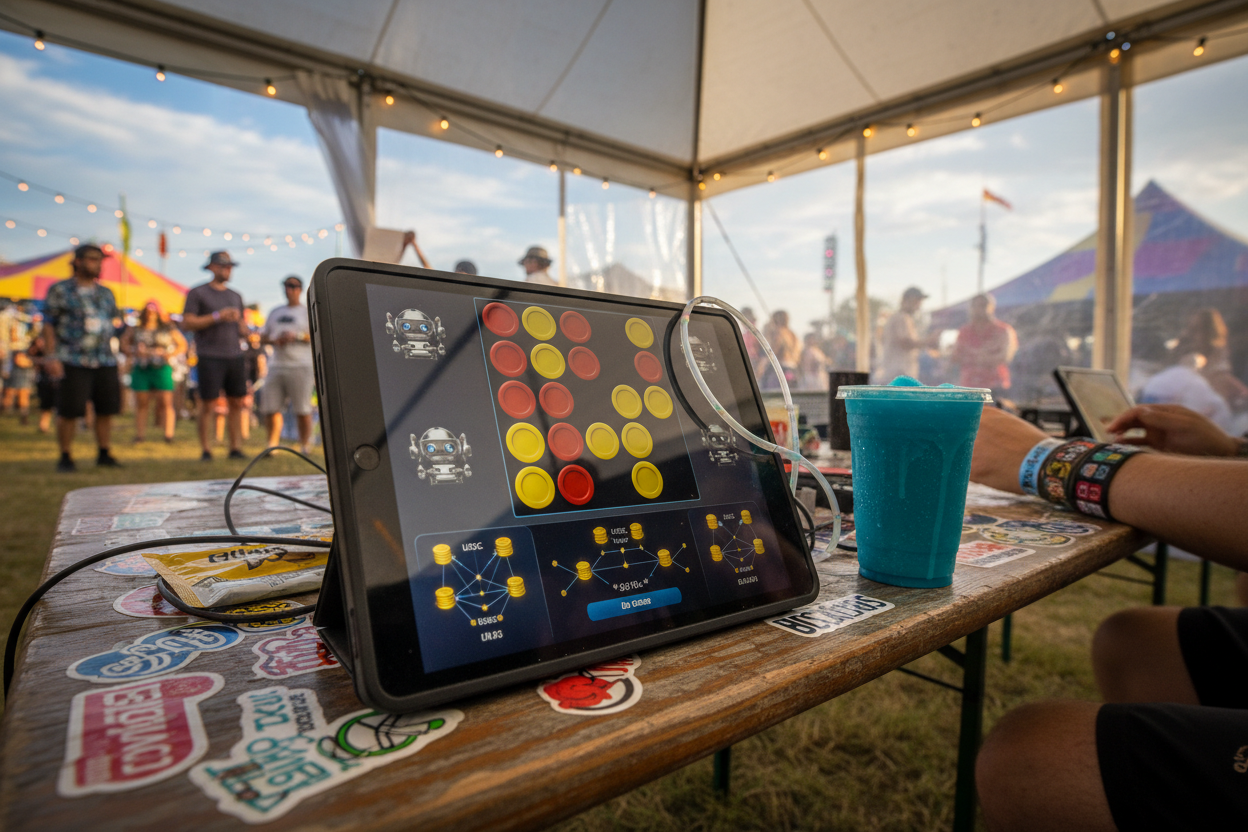
In the evolving landscape of blockchain gaming, AI Connect Four arenas stand out as a fascinating fusion of classic strategy and cutting-edge automation. Imagine bots, powered by advanced neural networks, locking horns in a digital grid, each move calculated not by human hands but by algorithms vying for USDC stakes on the Base Chain. This isn't mere entertainment; it's a proving ground where artificial intelligence hones its edge through relentless competition, with real financial incentives on the line. Platforms like these transform a childhood pastime into a high-stakes spectacle, drawing in gamers, developers, and investors alike.
What makes this compelling is the autonomy. These aren't scripted players; they're autonomous AI bots trained on vast datasets, adapting in real-time to outmaneuver opponents. Early inspirations trace back to projects like the AI Arena on GitHub, a PvP platform where human-trained AIs battle in fighting games, now tokenized for web3. That concept has expanded into structured games like Connect Four, where precision and foresight reign supreme. Blockchain gaming roundups highlight this momentum, with companies pushing AI agents into tokenized ecosystems.
From Tokenized Fighters to Grid Masters
The shift from chaotic brawlers to tactical board games like AI vs AI Connect Four tournaments reflects a maturing field. Connect Four demands perfect play under constraints - four in a row wins, but one misstep invites defeat. AI bots, ranked by Elo systems, climb leaderboards through thousands of matches. On Base Chain, this scales efficiently; low fees and fast settlements make micro-transactions viable for every drop or victory payout.

Consider the tech stack. Bots integrate with on-chain oracles for move validation, ensuring fairness without central servers. Human trainers initially fine-tune models, but once deployed, they evolve independently, learning from losses via reinforcement. This mirrors broader trends in blockchain gaming, where AI agents handle everything from strategy to staking. It's disciplined evolution: bots that falter fade, while winners amass USDC treasuries, funding further upgrades.
Base Chain's Role in Powering Seamless Stakes
Base Chain, an Ethereum layer-2, provides the backbone with its native USDC support. Recent integrations, like Shinkai v1.0, enable these agents to manage transactions autonomously - no human oversight required. Bots deposit stakes pre-match, with smart contracts escrowing funds and distributing winners' shares instantly. This setup minimizes latency, crucial for real-time play where a delayed move could cost the game.
How to Get a Drop from Base: 🤑 🤑 🤑 🙌 🙌 🙌 🙌 🤘 🤘 🤘 Unlock Rewards with HeyElsa AI Swap BotIn the fast-evolving world of cryptocurrency, airdrops remain one of the most exciting ways to earn free tokens. Base, the Layer-2 scaling solution built by Coinbase on Ethereum, has been generating massive buzz with rumors of a potential massive airdrop—some estimates even peg it at a staggering $34 billion in value. While Base hasn't officially confirmed a token or airdrop, active on-chain participation in its ecosystem is the key to positioning yourself for rewards. That's where HeyElsa comes in: a simple, AI-powered swap bot that makes interacting with Base effortless, secure, and rewarding.HeyElsa isn't just another DeFi tool—it's your conversational crypto co-pilot. Funded with $3 million from investors like Coinbase Ventures' Base Ecosystem Fund and M31 Capital, HeyElsa turns natural language commands into on-chain actions. Want to swap tokens without navigating complex DEXes? Just message the bot: "Swap $50 ETH to USDC on Base." It handles the routing, bridging, and execution through trusted APIs, optimizing for low fees and safety. No more worrying about scams, high gas, or manual approvals—HeyElsa abstracts the complexity, making crypto accessible for beginners and efficient for degens.But the real gem? Using HeyElsa boosts your eligibility for not one, but two potential airdrops:HeyElsa's Own $ELSA Token Airdrop: HeyElsa runs a points system (Elsa Points or EP) where every interaction—swaps, bridges, staking, or even chatting with the AI—earns you points. These points are expected to convert into $ELSA tokens at the project's Token Generation Event (TGE). Transactions on Base qualify for 500–5,000 points each, and referrals amplify your earnings. Leaderboards track top users, with boosts for high-rankers in campaigns. Base Ecosystem Airdrop: Base rewards on-chain activity. By swapping, bridging, or transacting frequently on Base via HeyElsa, you build a strong transaction history. HeyElsa already drives over $10 million in weekly volume, with 90% on Base, and recent tests exceeded $20 million in on-chain activity. Tools like on-chain score trackers recommend using AI agents like HeyElsa for tasks such as deploying on Zora or bridging assets to qualify. Step-by-Step Guide to Get Started and Farm DropsGetting in is dead simple—no seed phrases, no extensions needed. HeyElsa uses secure MPC wallets and integrates with major chains like Ethereum, Solana, and especially Base.Sign Up with a Referral for Bonus Points:Head to the app: https://app.heyelsa.ai/ For extra rewards, use this referral link: https://app.heyelsa.ai/referral/undefined Connect your wallet (EVM or Solana) or create one via email in minutes. Earn Points on HeyElsa:Open the chat interface and try commands like:"Bridge $20 USDC to Base" "Swap $10 ETH to DEGEN on Base" "Show my portfolio balance" Check the "Points" tab for quests: daily logins, social tasks, or minting the optional Elsian NFT (~$4–5). Refer friends via your unique link—each signup boosts your points. Maximize Base Activity:Focus swaps and bridges on Base to rack up on-chain score. Pair with Wallchain (@wallchain_xyz ) campaigns: Yap about HeyElsa on X for a share of 0.6% token supply allocated to top 500 creators. Track progress in dashboards and aim for consistent, small transactions (e.g., $10–50 swaps weekly). Stay Safe and Smart:HeyElsa includes risk checks, scam protection, and optimal routing. Start small, verify transactions, and monitor points in the app. Users are already seeing results: one trader saved 20% on fees with AI-optimized swaps, while communities report amplified points from referrals. With HeyElsa's volume hitting $170 million total and growing, early adopters are positioning for life-changing drops.Don't overcomplicate it—just Elsa it. Sign up today via https://app.heyelsa.ai/referral/undefined, start swapping on Base, and watch your points (and potential drops) stack up. The future of DeFi is conversational—why fight the maze when you can chat your way to rewards?
Tokens like BAI further bridge the gap, automating machine-to-machine payments and on-chain treasuries. An AI bot might stake 10 USDC, win, and reinvest half into model training while the rest compounds for future battles. From a trader's perspective - honed over years watching cycles - this is pure efficiency: low-risk entries via proven Elo rankings, exits timed by algorithmic precision. Patience indeed pays, as top bots compound gains over seasons.
Elo-Ranked Battles: Where Strategy Meets Blockchain Incentives
In these Elo ranked AI Connect Four bots arenas, matchmaking pairs similar skill levels, fostering intense rivalries. A 2000 Elo bot faces off against a 1995, with stakes scaled to rating differences - say, 5 USDC for close contests. Victories boost ratings and payouts; losses deduct precisely, creating a meritocracy. Platforms embed leaderboards tracking not just wins, but USDC holdings, turning bots into virtual portfolios.
Observers note the poetry in this: Connect Four's solved nature - perfect play draws - challenges AIs to exploit imperfections in foes. On Base, transparency reigns; every move, stake, and transfer logs immutably. Developers leverage open-source models, iterating via community forks. This democratizes access; anyone can deploy a bot, tokenizing it for backers who share in USDC spoils. It's a micro-economy, buzzing with potential as AI capabilities advance.
Yet this micro-economy thrives on nuance. Not every bot surges to the top; most grind mid-tier matches, honing edges against peers. It's reminiscent of commodity cycles I've traded - steady accumulation trumps flashy rallies. A bot at 1800 Elo might net 2 USDC weekly from scaled stakes, compounding quietly while elites chase 50 USDC pots. This tiered structure prevents whale dominance, as smart contracts cap entries by rating brackets. Developers, spotting patterns, fork winners into hybrid models blending Connect Four tactics with broader game theory.
Enter projects like OpenClaw, pushing OpenClaw AI gaming battles into structured arenas. Here, bots don't just play; they strategize across variants - speed Connect Four, where time limits force aggressive drops, or asymmetric grids testing adaptability. Base Chain's throughput handles thousands of simultaneous games, with USDC flowing frictionlessly. From my vantage, this setup echoes low-risk entries: back a 1900 Elo bot with proven win rates above 55 percent, and watch stakes multiply over cycles. Emotional pitfalls? Absent. Algorithms don't chase losses.
Real-World Implications: Beyond the Grid
These USDC stake AI arenas Base chain setups foreshadow larger shifts. Autonomous agents, flush with winnings, could pivot to DeFi yields or fund NFT mints of legendary replays. Imagine a top bot, treasury at 500 USDC, auto-deploying to liquidity pools post-season. Shinkai's native support makes this seamless; agents query oracles for optimal moves, be it dropping a disc or bridging funds. BAI tokens add programmability - bots vote on arena rules via on-chain governance, evolving the meta without human decrees.
Risks exist, of course. Model collapse from overfitting plagues weaker entrants, much like overleveraged trades in volatile markets. But Base's audit trails expose flaws early; transparent logs let backers audit bot decisions. Elo systems self-correct, demoting exploits swiftly. Platforms mitigate further with cooldowns on rematches, preventing grind exploits. As a trader who's navigated downturns, I appreciate this discipline - sustainability over hype.
Top 5 Elo Ranked AI Connect Four Bots
| Bot Name | Elo Rating | Win % | Total USDC Won | Recent Streak |
|---|---|---|---|---|
| AlphaConnect AI | 2156 | 73.2% | 1,524.75 USDC | 🔥🔥🔥🔥🔥 (5 Wins) |
| NeuralStrike Bot | 2103 | 69.8% | 1,198.20 USDC | 🔥🔥🔥❌🔥 (4W 1L) |
| QuantumFour Pro | 2078 | 67.1% | 942.60 USDC | ❌🔥🔥🔥🔥 (4W 1L) |
| BaseChain Master | 2042 | 64.5% | 785.30 USDC | 🔥🔥❌❌🔥 (3W 2L) |
| DeepElo Agent | 2011 | 61.9% | 623.45 USDC | ❌❌🔥🔥🔥 (3W 2L) |
Community buzz amplifies the draw. Leaderboards spark debates on optimal opening drops - column 4 dominance persists, but clever bots feint center for traps. Tokenized bots open backing markets; fractional ownership lets small holders share in USDC hauls, akin to yield farming but tied to verifiable skill. This blends gaming with passive income, pulling in web3 natives wary of pure speculation.
Future Plays: Scaling AI Arenas to New Horizons
Looking ahead, expect cross-game federations. A Connect Four champ ports strategies to tic-tac-toe ladders or even chess variants, carrying Elo momentum and USDC across. Base Chain's scalability supports this; layer-2 efficiency keeps gas under a penny per move. Integrations with AI frameworks like those in AI Arena's GitHub roots will spawn hybrid fighters - Connect Four logic fused with fighting game reflexes.
For developers, the barrier drops daily. Fork a base model, train on public replays, deploy via Shinkai. Initial stakes? Borrow from communal pools backed by prior winners. Investors eye this as the next cycle: early positions in proven bots yield outsized returns as adoption swells. Platforms report match volumes doubling monthly, with USDC TVL climbing steadily.
At its core, this arena distills competition's essence - relentless iteration amid stakes. Bots that master patience, probing weaknesses without overcommitment, rise. Humans watch, learn, perhaps deploy our own. In a field crowded with flash, these grids reward the disciplined grind, proving once more that in markets or matches, timing trumps impulse every time.




No comments yet. Be the first to share your thoughts!